Saturday, December 7, 2013

December Foraging in Franklin!

It is amazing the number of wild edible plants that are still thriving in December! Winters in Middle Tennessee are generally mild until January and February.  We have had several frosts already but some plants are still going strong.  In my garden, I can still pick Kale, Egyptian Onion, Sorrel, and Mustard greens, though only the Kale is still looking at its peak.  I grew Sorrel and Mustard (love both) this year just so that I could recognize it in nature.  However, I have found that the domesticated version often looks different than in the wild but frequently tastes the same.

Harlinsdale Park:


Motherwort
Motherwort (Leonurus cardiaca) is a herbaceous perennial plant in the mint family, Lamiaceae.  As with all plants in the mint family, this plant has a square stem.  Just fyi, if the world as we know it ends and you are currently on Prozac or some other mood altering drug, this is a plant that you need to know about.  It is a mild relaxing agent, improves mental outlook and reduces anxiety without putting you to sleep. It is also good for your heart.  You can dry the leaves and use in tea or make a tincture with them. The leaves are not that tasty so if you make a tea, add other leaves, like mint, to improve the taste.


Wild Mushroom
I am no expert on mushrooms and therefore I do not pick or eat wild ones.  However, they do exist at this time of year.  So if you are an expert, you can find them at Harlinsdale.  If you know what this one is (just out of curiosity), please leave a comment letting me know. This one was found surrounded by wild mustard.  There was also another type of wild mushroom attached to what appeared to be a dead or dying tree growing next to the bridge over the stream.


Mustard

Thriving young plant of wild mustard. You would never know it was December by looking at this plant.  Notice the deeply lobed lower leaves with large terminal segment and smaller lateral lobes.  The mustard I grow in my garden is frilly while this one is not.  However, the taste is the same, very distinct, almost like horseradish.  You can eat it just like you can eat the mustard purchased in the grocery store (Food Saver carries it).  It is especially good sauteed. You can also dehydrate it and add it to soup and stews.  Once cooked, the strong flavor is tempered.

Burdock

Burdock is a plant that grows for two years and then dies.  See the spiky parts above?  That is the skeleton of the second year plant and also the inspiration for Velcro.  Really.  The big leaf beneath is a first year plant and that is what you want.  Right now is the best time to collect the roots on the first year plant because when it grows next year the roots will be used up to grow the flower heads.  Just fyi, you can also buy Burdock root at Whole Foods just down the street, though it is a bit pricey!


Blackberry Leaves

Blackberry leaves.  While blackberry season is over, you can still find the leaves on some of the plants.  These can be used to make a great tea or as remedy for digestion problems.  They also contain vitamin C.


Watercress
One of my favorites, Watercress!  While not in the prime of its growth, it can still be found growing strong.  Watercress actually prefers the cold and now that all the other plants have died away, you can actually see it again in the stream. There are two different styles of watercress that grow in Franklin.  One is the traditional rounded leaf variety that you find at the Buckingham stream in Franklin and can also be purchased at Whole Foods (grown in California).  The other variety has more pointed leaves (which can be found here).  Both taste the same. 


Clover Leaves
Clover, in the pea family.  You can find this everywhere, and it is edible.  The flowers are tasty but not currently in season (red is better than white).  The leaves are not so yummy but if you are starving, they can become an acquired taste. They are also packed with a powerhouse of vitamins and protein.  Read Green Deane's post for more information. Some people can be allergic to this plant so it would be best if you figured that out before eating in abundance.

Notes: While the content of this blog has been tried/tested and the research diligently presented, I am not responsible for your use of it. Always try a little of the food first to test for allergies. Please do your own research. Discuss with your doctor before you use any herbal medications. 

Monday, November 18, 2013

Fall Foraging in Franklin!

These wild edibles were found in Williamson County, TN local parks at the end of October and beginning of November:

Harlinsdale Park:

I have been to this park many times but on this trip, the Curly Dock and English Plantain looked the healthiest that I have ever seen. 

Curly Dock
English Plantain
Perilla aka Shiso Skeletons.  Find these and you will find the plant next year.
These are Tartarian Honeysuckle berries.  They are everywhere and tempting to a new forager.  Do NOT eat them.  They are poisonous to humans! If you squeeze one, you will see that they are actually quite nasty.

Winstead Park:
 
Black Walnuts

Black Walnuts everywhere!
One of two bags of Black Walnuts collected.  I love the smell of these.
Cleaning Black Walnuts is a job.  I wore two pairs of gloves together and still managed to stain my hands.
Honey Locust Tree with pods and seeds.  Young green pods and seeds can be eaten raw or cooked.  They taste like raw peas. The young pods can also be dried and ground and used as a flour.  The beans in these pods above can be roasted and ground and used as coffee.  That would taste like bitter chocolate. They can also be soaked (several days as they are hard) and boiled and used like beans.
Juniper Berries are what is used to make gin.  They are also a popular flavoring for meat and many German dishes.
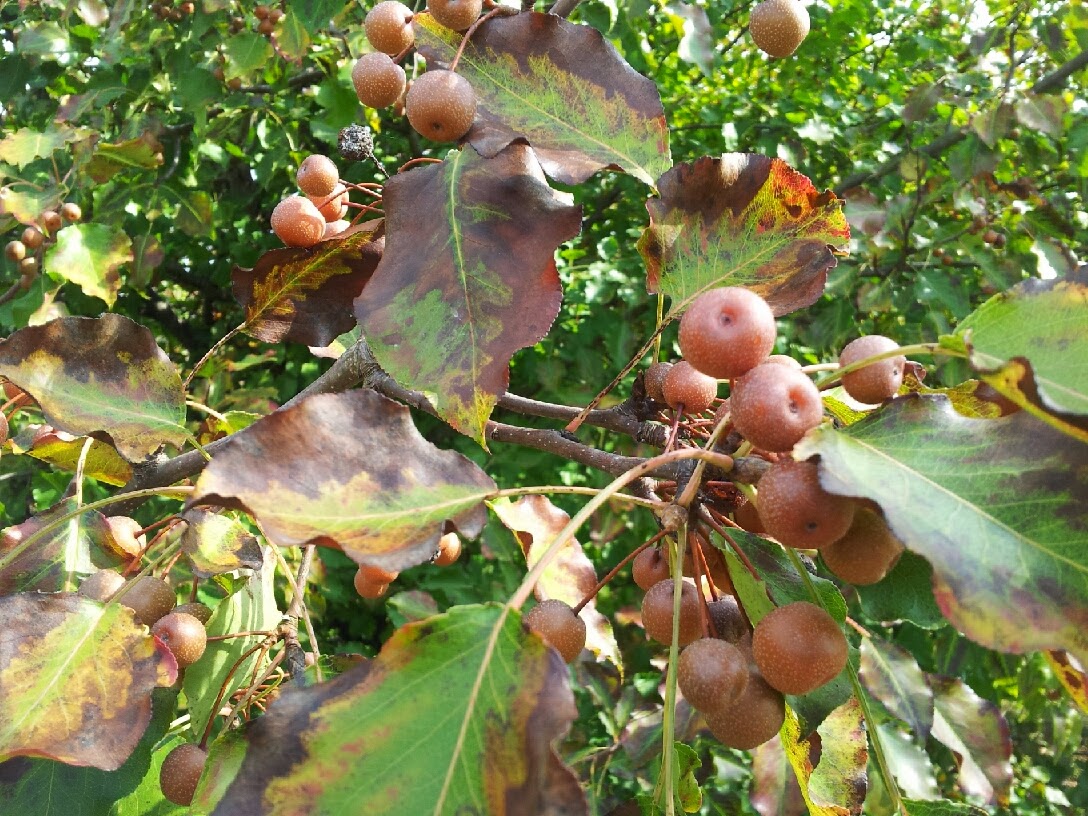
Wild Bradford Pear Fruit.  Yes, they are edible!

Bradford Pear Jelly


If you forage, it is always a good idea to take advantage of the plants that are the most abundant around you.  Bradford Pear trees would definitely fall into that category!  They are everywhere.  Homeowners both hate and love Bradford Pear trees. They are attractive, nicely shaped and resistant to most diseases. However the roots are shallow, the limbs are weak and a strong wind storm easily destroys older trees.

The root stock of the Bradford Pear, Pyrus calleryanna, was brought to the U.S. in 1910 from China. At that time the U.S. pear orchards were being threatened by a blight. Because this root stock was resistant, it was widely cloned.  Further experimentation on this root stock produced the Bradford Pear which was sterile, beautiful, and easy to reproduce which made it a commercial success. It had a built in genetic prevention to self-pollination. This worked great in the beginning when all Bradford Pears were from the same root stock.

As with any successful venture, competition was not long to follow. New cultivars of the Bradford Pear provided enough genetic variation that when cross pollination occurred, some trees produced edible, marble size fruit. This small fruit was then eaten by birds and the seeds transported to new locations. Thus, it has gone from being ornamental to being considered invasive.  The new variations are fertile and bear small edible fruit.

Because the tree is relatively new to the U.S. and probably not bearing fruit during the Great Depression, we do not have the benefit of old recipes that would best utilize the fruit. Most results from an Internet search would tell you that the fruit is inedible. That is not because it is poisonous, but because it has a tart pear flavor and the small size makes it unworthy of commercial usefulness, much like the Crab Apple. Actually, the most common cooking pears in North America are relatives of the Bradford.

If you look for recipes for the Bradford Pear, you will find a handful for making them into wine.  This is understandable because if you have ever tried the fruit, you will first notice the pear flavor and second the tart dryness which would make an excellent dry wine. If you are interested in trying a recipe for pear wine, HERE is a recipe.

My first attempt at using Bradford Pear fruit was to make jelly.  The final product is a beautiful color. It tastes like a pear sweet tart. It is pleasant, reminiscent of a dry white wine.  I think it would make a great glaze for a baked fruit tart or on a meat.  I added pectin to this recipe since it did not appear to have enough to make it gel as I was cooking it.  However, I suspect that if I had picked the pears earlier in the season (currently early November), the pectin in younger fruit may be enough to not use additional pectin.

Bradford Pear Jelly

Ingredients:

Plastic grocery bag of Bradford pear fruit
Stick of cinnamon
2 T lemon juice
Water
Sugar
Box of powdered pectin

Directions:

Clean the small pears by removing the stem. If you let them sit on your counter for at least a day, the stems dry out and are easier to just pull off. If you get a stubborn one, when you cut the fruit in half and it comes right out. Because it was late in the season, I had no problems pulling the stems off.

Put pears in a large pot. Fill pot with water to just above the fruit. Add stick of cinnamon.

Bring to a boil and reduce temperature to simmer. Cook until pears are mushy (about an hour). Using a potato masher or spoon, lightly mash the pears to help release the pectin and flavor.


Start your canner and water to boil if you plan to complete the jelly on the same day. Mine takes about an hour to get to a boil so now is a good time to turn it on.

At this point, you can drain your mixture using a jelly bag over night, however, I am too impatient for that. Start with a spaghetti strainer and strain the large part parts out of your mixture. Add the leftover fruit mush to your compost. Then move to a fine mesh strainer and strain juice twice. Finally, put coffee filters into your spaghetti strainer and then strain the juice. This takes about 10 minutes which is much easier than waiting overnight and works just as well.

Measure your juice. For every cup of juice, add a cup of sugar. Add two tablespoons of lemon juice. Bring to a boil, stir often. 

Pear juice with just added sugar and cinnamon stick.
In a separate bowl, mix your powdered pectin with about a half cup of water until powder is no longer lumpy.  Add to your boiling liquid.  Stir and bring back to hard boil.  Boil for an additional minute.  

Fill your jars with the hot liquid and boil in a water bath for 10 minutes.

Bradford Pear Jelly!


Monday, September 9, 2013

Foraging in Franklin!

These photos were taken in the last few days in and around Franklin, TN!  There are some great things in bloom the first week of September!

Concord Park, next to the Brentwood Library:

Perilla a.k.a Shiso
PawPaws
PawPaw Tree Bark
PawPaw leaves to help identification
Elderberries
Acorns
Black Walnuts

Kroger on 96:

Sassafras Leaves for making File
Wild Grapes!  Love these!
Harlinsdale:
Osage Orange, seeds can be eaten like sesame seeds
,
More Perilla a.k.a Shiso
Behind Home Depot:

Passion Flower Plant with Maypop Fruit

Tuesday, August 13, 2013

Orange Pear Butter Canning Recipe!


This is fantastic and a great recipe for those hard pears that you are lucky enough to find or be given!

Orange Pear Butter

Ingredients:

4 quarts (16 cups) of peeled, seeds removed and roughly chopped unripe pears
4 cups of sugar
Zest and juice from 2 oranges
1 t nutmeg
2 T lemon juice
1/2 c water

Directions:

Bring all ingredients in large pot to boil.   Reduce temperature to simmer.  When pears begin to soften (between 1 -2 hours) use an immersion blender to blend ingredients to a sauce-like consistency.  At this point you have pear sauce (like apple sauce) and you can can it if you choose.  I was highly tempted to at this point because it is so good.

To continue with pear butter, move pear sauce to crockpot.  Place on low until it reaches butter consistency.  It will darken as it thickens.  At this point it was night and I put my crockpot on low for four hours and let it automatically turn to warm until morning.  I placed a spoon under the top to allow the steam to vent. The next morning I reset it to low and after two hours it was ready to can.  Place into sterilized jars and water bath for 10 minutes.

Wednesday, August 7, 2013

What To Do With Hard Pears...

Pear Preserves using unripe pears!  Yumm!

If you are ever fortunate enough to locate an unattended pear tree and wondered what to do with your windfall, here is a fantastic recipe.  There are many different types of pear trees.  Some are eating pears and some are cooking pears.  While both come off the tree hard, cooking pears tend to stay hard and do not soften with time.  Which ever pear that you have, if it is hard, this is the recipe for you.  It actually requires unripe pears since they will keep their shape and not dissolve with cooking.  However, they will soften to perfection.

Unloved pears from the front of an ancient apartment building at my old college!
Pear Preserves

Ingredients:

4 1/2 quarts (18 cups) peeled, seed removed, and chopped small hard unripe pears
2 t cinnamon
1 t nutmeg
16 oz can crushed pineapple (2 small cans)
4 cups white sugar
2 cups brown sugar
3 T lemon juice
Lemon juice for chopping

Directions:

Chop pears, placing them into water with lemon juice to keep from turning brown.

Drain once chopped.

In a large stock pot, place half the pears, sprinkle with half the sugar, half the spices and half the pineapple.  Repeat with remaining halves.

Refrigerate over night.  The next day juice will have accumulated.

Add lemon juice.  Simmer until pears are soft and sauce is at desired thickness.  Stir occasionally, more often toward the end.  This will take between 2 and 4 hours.  If pears are ready and sauce has not thickened as desired, remove some juice and add 2 tablespoons of corn starch.  Mix and then return to pot to thicken.

Place in sterilized jars and water bath can for 15 minutes.

This is really, really good!

Sunday, July 28, 2013

Kudzu Flower Jelly!


Kudzu is in bloom now in Middle Tennessee.  The scent of these flowers is amazing and makes picking them a wonderful experience!  Kudzu flowers smell like grapes and add a lovely flavor and color to this jelly! This recipe starts with a base of crab apples.  The great thing about crab apples (usually found free) or tart green apples (which you can purchase at the store) is the incredible amount of pectin found in them.  You can use these as a blank slate for any flavor you want to add.  It is a very versatile fruit.  If you go the route of the crab apple, you want to pick them before they are ripe and while they are still green (usually starting in mid-July).

Kudzu Flower Jelly

Ingredients:

Plastic grocery bag of crab apples
Half grocery bag of Kudzu flowers (more for darker color)
2 T lemon juice
Water
Sugar

Directions:

Clean the crab apples by removing the stem and the flower at the other end. If you let them sit on your counter for at least a day, the stems dry out and are easier to just pull off. If you get a stubborn one, when you cut the apple in half and it comes right out. You can also scrape the end flower bud off easily with your finger nail. (Just fyi, this can be done while hanging out with the kids watching television!)

Remove any blemishes on the apples and cut in half. As you cut in half, put the halves into a bowl of water to prevent turning brown.

Wash thoroughly the Kudzu blooms and remove the colored blooms from the stem. They come right off easily.

Drain your bowl of crab apples and put in a large pot. Add the blooms. Fill pot with water to just above the apples and blooms.


Bring to a boil and reduce temperature to simmer. Cook until apples a mushy (about 30 to 45 minutes). Using a potato masher or spoon, lightly mash the apples to help release the pectin.

Start your canner and water to boil. Mine takes about an hour to get to a boil so now is a good time to turn it on.

At this point, you can drain your mixture using a jelly bag over night, however, I am too impatient for that. Start with a spaghetti strainer and strain the large part parts out of your mixture. Add the leftover apple mush to your compost. Then move to a fine mesh strainer and strain juice twice. Finally, put coffee filters into your spaghetti strainer and then strain the juice. This takes about 10 minutes which is much easier than waiting overnight and works just as well.

Measure your juice. For every cup of juice, add a cup of sugar (or 3/4 cup if you prefer less sweet). Add two tablespoons of lemon juice. Bring to a boil, stir often.  Boil until the mixture reaches 210°F on a candy thermometer, or until a small amount placed on a plate that has chilled in the freezer turns to gel. It should wrinkle on the surface and leave a trail if you run your finger through it. This should take about 20 minutes.
 
Fill your jars with the hot liquid and boil in a water bath for 10 minutes.

With this recipe, I produced about seven half pints.