Showing posts with label Poke. Show all posts

Friday, May 27, 2016

May Foraging Near Murfreesboro, TN

This past week I was fortunate to forage in a lime stone glade in Murfreesboro, Tennessee.  I live about an hour west of this location and in just that distance, much of the vegetation changes.  There is far more limestone in this location with a thinner crust of dirt covering it.  As expected, you will find vegetation more able to bare heat and often thriving on it.  What you will see are very hardy plants.  One of the reasons I like wild edible/medicinal plant is that they have not been tended and have survived and flourished with out the intervention of gardeners.  In other words, the strong do survive!


Some of the plants are more common than others.  Some are unique to this area.

White clover, Trifloium repens, is prolific in the mid-south right now.  There are fields of it.  It is in the pea family and edible from root to blossom.  It is also highly nutritious and high in protein and fiber!  The flowers can also be used to make tea, as an addition to a salad or dried and ground into a flour for baking.  However, some people are allergic to clover so try just a little to begin.

Mullein, Verbascum thapsus in the Scrophulariaceae family, is not used for food but is an important herb for medicine.  If you are interested in herbal remedies, this is a plant you should have in your garden.  It is primarily used for respiratory ailments.  It has been used as an effective treatment for asthma, whooping cough, bronchitis, hoarseness, pneumonia, earaches, colds, chills, flu, allergies, tonsillitis, and sore throat.  The herb produces an expectorant action which is attributed to the triterpenoid saponins present. Additionally, it contains tannins which help shrink inflamed and swollen respiratory passages, thus allowing for easier breathing.  Mullein also is rich in mucilaginous substances, called polysaccharides, which protect mucous membranes, preventing the membranes from absorbing toxins.  This produces a soothing and cooling effect to the lungs and throat.  It also has an antispasmodic effect, relaxing muscles and relieving chronic coughing.  It has even been an effective treatment for tuberculosis since it inhibits mycobacterium, the bacteria which causes the illness.  Indians smoked the dried leaves as a remedy for lung ailments.

Other uses for this plant include as a remedy for complications to Lyme disease, urinary incontinence, recurring bladder infections, interstitial cystitis and to treat spinal and muscle injuries. It also has a mild narcotic effect on some people and has been used as a sleep aid and to relieve abdominal cramping.

A salad in one photo!

Curly Dock, Rumex crispus in the Polygonaceae family (buckwheat), is one of the earliest spring greens and one of my favorites.  It is one of three docks I have found growing in middle Tennessee.  The other two are broad leaf and smooth dock.  All can be used interchangeable.  The leaves can be used as greens similarly to spinach.  The flavor is usually mild with a bit of tartness which is not obvious when cooked.  You can chop and add to soups, sauces and chili.  It can also be added to meatloaf or meatballs for that touch of green.  If boiled too long it will turn to mush.  It can not be canned for this reason.  By mid summer it will produce a plume of red seeds that can be picked and ground for flour.  It makes a nice dark bread.  It is an excellent source of vitamins A and C, as well as the minerals iron and potassium.

Dock does contain oxalic acid so consuming too much of it may be an issue to some people. Oxalic acid is also found in spinach, chocolate, bananas, parsley, tea, beer, rhubarb and almonds. Also, our bodies create it naturally.  It can prevent the absorption of nutrients or be toxic in super high doses.  Thus, eat in moderation.

Common Plantain, Plantago major, is another frequently found plant.  To an herbalist, it's a crucial healing plant, particularly for treating skin conditions. As a matter of fact, if you have a bug bite or poison ivy, you can chew up some of the leaves of this plant and put it directly on the skin and it will take away the sting or itch and aid healing. That's a nice trick to know! It is used as an astringent and helps to heal infections, include eye infections like conjunctivitis. This herb is commonly used to make skin salves, teas, poultices and tinctures. It has been called Snakeweed in the past due to its ability to draw our poison from a wound or snakebite. A tea or infusion of plantain leaf has even been used as ear drops for ear infections (as long as the ear drum has not burst) to aid in healing and reduction of pain. Historically, it has been used to treat lung conditions (expectorant), stop diarrhea in children and treat yeast infections. The Anglo-Saxons considered it one of their nine sacred herbs and it was even mentioned by William Shakespeare in Romeo and Juliet in reference to its skin healing properties.
It is also quite edible, though you must look for young leaves usually found in early spring. As the plant ages, the more bitter and fibrous it becomes. However, if you are starving, you can boil the plant in several changes of water to reduce the bitterness. Older leaves have a more woodsy flavor and is best eaten pureed. When the leaves are young and no longer than about four inches, they have a nutty, asparagus-like taste. The leaves can be used like spinach.  However, there are lines in the leaf that contain strings.  It is best used if you cut against the grain of these lines to sever those strings.  The leaves can be successfully canned.  The seeds are also edible and can be ground to make a form of flour. In recent studies of plantain seeds, they have been attributed to lowering cholesterol. 
 
Nutritionally, the plantain is high in iron, and rich in vitamins A, C and K, as well as numerous other vitamins and minerals. It is a powerhouse of beneficial chemicals in healing and preventing disease.
 
Wood Sorrel, Oxalis Acetosella, is a wonderful lemony flavored plant often confused with clover.  It is of similar size but the leaves are heart shaped with a dip in the center rather than round.  It is one of those plants that is easy to pick and pop in your mouth for a refreshing tart flavor. It also contains oxalic acid.  It grows world wide and has a long history of use by native Americans.  It goes well in salads and in sauces for fish.

Virginia Creeper, Parthenocissus quinquefolia, while not considered edible does have some medicinal qualities.  However, it also can cause allergic reactions similar to poison ivy in some people.  It likes to climb and has been used in landscaping because of this and its brilliant red color in the fall.  There are some references to its benefit medicinally in internal use in tea form though in my opinion, this is a plant to use caution.  However, the use that appears to be of most interest is that reportedly when the leaves are used in a decoction externally, it is said to cure head lice in children.

Perilla, Perilla frutescens in the Lamasceae family (mint), is also known as Shiso, a native of India and an herb commonly used in Japanese and to a lesser degree Chinese and Korean cuisines.  Pepsi even made a Perilla flavored soda for that part of the world.

Shoots will begin to appear in March and flower by the end of summer.  Perilla is easy to grow and will reach heights of two to three feet.  Varieties of this plant can be either green or purple and can cross pollinate.  There are even versions that can be frilly, and ruffled-leaved. While it is not a perennial, it does quite successfully reseed itself.  Much like basil, it can grow in partial shade or sun.  The leaves of the Perilla plant are high in Vitamins A and C.  They are rich in fiber and riboflavin.  Minerals include calcium, iron and potassium.  

The plant has been used as an anti-inflammatory and it has been known to have preservative effects on other food due to the presence of terpenes such as perilla alcohol.  In Japan, the oxime of perillaldehyde (perillartin) is used as an artificial sweetener since it is about 2,000 times sweeter than sucrose.  While the seed oil is edible and contains a high concentration of alpha-linolenic acid, a kind of omega-3 fatty acid, it also contains a chemical that is a potential lung toxin, thus should not be used as a cooking oil. The leaves, on the other hand, have been used in culinary creations for hundreds, if not thousands, of years.  The flavor is best when the leaves are used fresh. It has a flavor like a cross between anise and mint.  The leaves can also be successfully dried and used as an herb.

Chickweed, Stellaria media, is one of the most common edible succulent weeds in the South.  It can grow year round but does not like intense heat preferring cool, wet weather.  It is frequently described by foragers as one of their favorite edibles.  It grows low to the ground usually in dense, tangled mats.  You can even find it in the cracks of sidewalks in the city.  It is stringy and flexible with pointed oval leaves that grow in pairs along its stem.  When it blooms it has a white flower with five petals.  However, the petals are notched in such a way that it appears to have ten petals.  These tiny flowers at the tip of the plant will eventually drop tiny brown seeds.  Chickweed has nitrogen-fixing qualities for your garden which probably benefited the above garlic.  It is a great plant for beginning foragers.  It is called chickweed because chickens love to eat it.  It is a delicate crunchy green with a mild earthy taste much like alfalfa sprouts.  It is wonderful in salads and provides choline, vitamin A, vitamin C, vitamin B6 and B12, beta carotene and vitamin D.  It contains the minerals calcium, potassium, phosphorus, zinc, iron, manganese, sodium, silica, selenium, and copper.

Some recent research has shown that it can be an effective antihistamine.  Chickweed also contains saponins that break down fat cells and which many herbal weight-loss formulas contain.  It has been referred to as nature’s diet herb.  It has also been attributed to helping arthritis, rheumatism, bladder issues and gout.  It reduces inflammation and helps to regulate thyroid and metabolic function according to some sources. It can be used externally to treat skin problems.

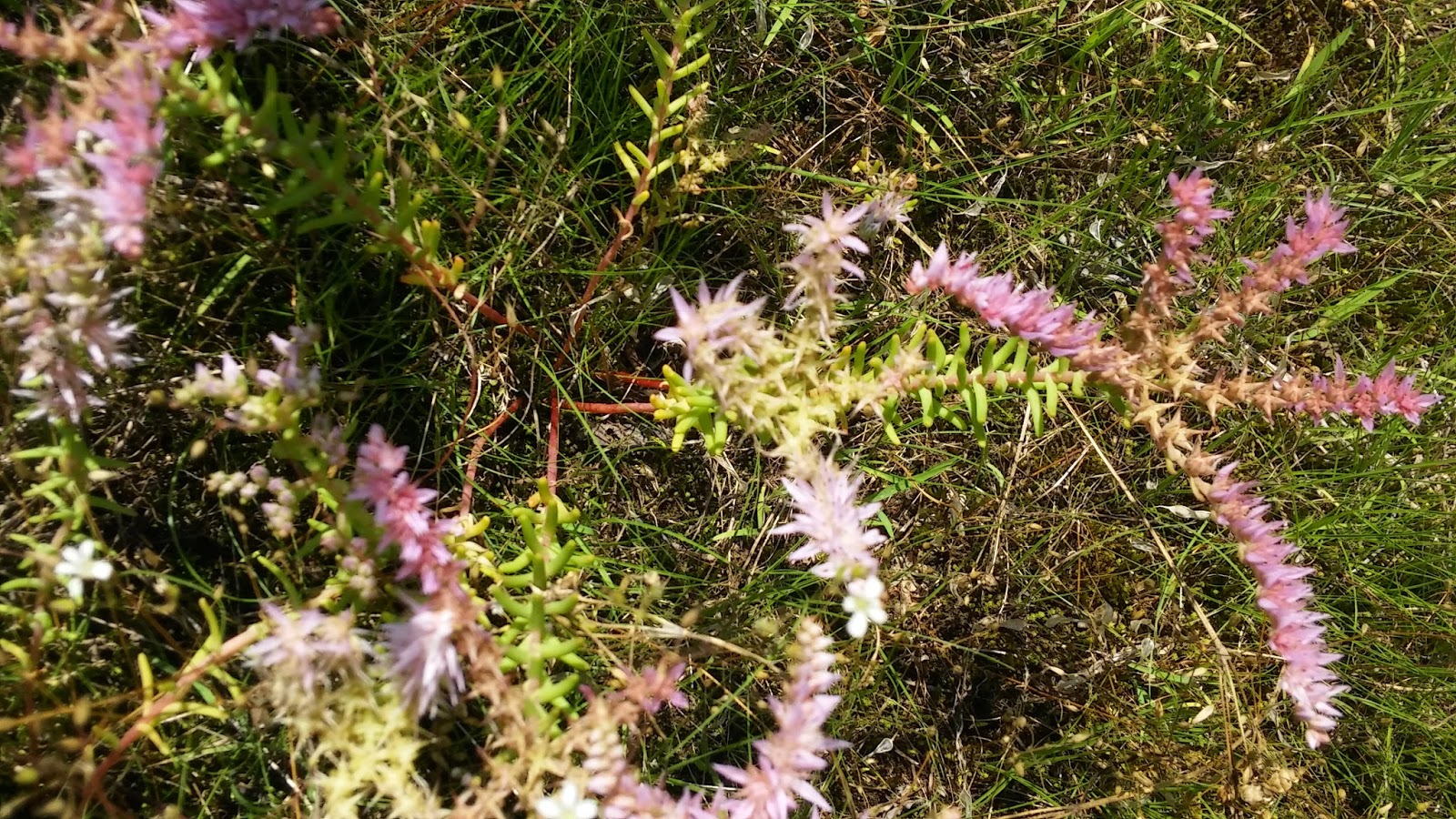
Widow's Cross, Sedum pulchellum, also known as a stonecrop, is one of the tough succulents that thrives on limestone with the full exposure of the Southern sun.  When the summer moves into dryer heat the plant will shrivel and drop its seeds into the rock cracks and wait until rainy season returns to sprout again.

Most Sedum are edible but some, particularly those with yellow flowers such as Goldmoss Sedum, are mildly toxic and eating too much will cause stomach upset and the hybrid Sedum rubrotinctum, aka "Pork and Beans" or "Jelly Beans" has been reported as toxic.  Some Sedum are more bitter than others making them undesirable.  They have been used in salads, cooked and pickled.


These lovely berries and leaves growing on what appears to be bushlike structures can easily be mistaken for poison oak or poison ivy.  They grow in leaves of three but in this instance you do not need to leave them be!  These are Fragrant Sumac, Rhus aromatica.  It is the lesser known of the three most common edible Sumacs: Staghorn, Smooth and Fragrant Sumac.  They are close cousins to poison ivy, poison oak and poison sumac though they have a feature that sets them apart.  The poisonous varieties all have white or yellowish berries while the edible varieties are a variation of red. However, super sensitive people may have a reaction to edible sumac so proceed with this in mind.

Sumac is often used to make a lemonade-like drink.  The outside of the berries have a citric taste to them and when soaked in water, creates a resemblance to lemonade.  The berries are also often used to create a popular middle eastern spice called Za'atar.  The citric taste to the berries is the primary attraction to this fruit so you do not want to wash it or pick it just after a rain. The best time to pick sumac is late summer before they have dried on the plant.

The leaves have a pleasant citrusy smell when crushed.  Reportedly, native Americans would mix it with tobacco to smoke.  An examination of the leaf structures will also help to distinguish Fragrant Sumac from Poison Oak or Poison Ivy.  Fragrant sumac has a sessile (no petiolule) terminal leaflet. In other words there is no stem between the end leaf and the other leaves.

Photo from Arkansas Native Plant Society

Staghorn, Smooth and Fragrant Sumac berries can all be used similarly.  There are numerous recipes online worth trying.


Prickly Pear Cactus, Opuntia humifusa, is highly edible. Both the pads and the red fruit that the plant produces can be used in numerous recipes. This cactus has been a frequent ingredient in southwestern and Native American cuisine.

The best time to harvest the cactus paddles or "Nopales" is in the late spring while the fruit or "Tunas" is in the late summer. There are two types of spines on these pads that you must eliminate before cooking. You will see large smooth fixed spines and small hair-like spines that are called glochids. It is these glochids that will cause you the most pain! They easily penetrate the skin and detach from the plant. There are two ways to remove the glochids from the pads or fruit. You can either cut/scrape it off or you can burn it off. If a blow torch is not convenient, I would suggest the scraping. To harvest, use a knife (or twisting/bending motion) and tongs. I would also suggest using gloves, thick ones. You can actually buy the cacti in Spanish markets already de-spined and sliced, ready for cooking. So when you are cursing about the stickers in your hand, remember that people pay big bucks for this delicacy! Duct tape or Elmer's glue can be used to remove splinters.

The pads of the Prickly Pear have a taste similar to green beans and a texture like okra. The red fruit is slightly sweet and similar to a cross between a pear and a beet. The pads are typically boiled, grilled or fried while the fruit is often made into jelly, added to smoothies or eaten raw. The pads are not peeled. Just carefully remove the spines before slicing and cooking. For the fruit, if you cut the ends off and then cut in half or make a slice down the side of the body, the peel comes right off. You can also easily scoop out the seeds with a spoon. The flesh is the part in which most people are interested, though the seeds are edible as well. To juice the prickly pear fruit, place the "husked" (still with seeds) prickly pears into a blender or food processor and pulse until liquefied. Poor into a fine mesh sieve and press out the juice into a bowl. Discard the remaining seeds and pulp. Depending on the size, between six and twelve prickly pear fruits will give you one cup of juice.

Research on the nutrition of the prickly pear suggests that is can lower bad cholesterol and lower the need for insulin in diabetics. It has many antioxidant properties and is rich in vitamin C, iron, beta carotene and calcium. Due to its high fiber content it has also been used to improve the digestive system.

While a person who has never eaten prickly pear before might find the idea of eating something with spines on it to be a bit crazy, there are numerous accounts of people who grew up eating it, still crave it and reverently pass down recipes for it.


Indian Plantain, Arnoglossum plantagineum in the Asteraceae Family, also known as Groovestem Indian Plantain or Prairie Indian Plantain.  It is not closely related to Common Plantain.  While not reported as edible there are possible medicinal qualities.  Cherokee Indians used it as a poultice for cuts, bruises, tumors and infections.

Purple Tassels, Dalea gattingeri, or Dattinger Prarie Clover in the Fabaceae family (legume).  It is a characteristic plant of the shallow soils of limestone glades in middle Tennessee. There are only a few locations known outside of this area.  It is a perennial hermaphrodite plant. It is a nitrogen fixer and can not grow in the shade.  It is a very fragrant plant.  According to PFAF, the roots can be chewed and the leaves can be dried and used for tea. It is drought tolerant and will stay green until a hard freeze which is usually December or January in Tennessee.


Wild Salsify, Tragopogon dubius, also known as western or yellow salsify and Goat's Beard.  Its nickname is Johnny-Go-To-Bed-At-Noon because the flowers open in the morning and close at mid-day because of the heat.  It is a close cousin to dandelion. It is a hardy annual and not shade tolerant.  It loves poor soil. When going to seed it looks like a giant dandelion seed head.

The roots, leaves and flowers are edible.  The flavor is very mild.  Some foragers say that it is one of the best lettuce like wild plants available.
Horsemint, Mentha longifolia, a wild mint, also known as lemon beebalm.  The flowers and young leaves of this plant add a wonderful herbal/citrus flavor to tea.  If watered, this plant will continue to flower until the end of summer.  The leaves are high in thymol which have a sedative effect making it a good drink before bed and a remedy for upset stomachs.

Lyre Leaf Sage, Salvia lyrata in the Lamiaceae family.  It is a mild mint and has been used as a cough and cold treatment in a tea form.  According to folk medicine, fresh leaves can be applied to warts for removal, as well as the leaves and seeds can be made into an ointment to heal wounds and sores.  Young leaves are also edible in salads.

Recently another forager successfully collected the seeds and used them as one would use Chia seeds (also in the mint family, closely related).  They have the same mucilage properties as Chia. The verdict when used was that it had a better flavor.  The method she used to collect the seeds was to run her hand up the stalk and after collecting about 1-2 cups, she gently rubbed them in her hands, then dropped them into a bowl in front of a fan that blew the papery chaff away.

Store bought Chia seeds (L) and Lyre Leaf seeds (R). Photo by Mona Folds.

Lyre Leaf seeds.  Photo by Mona Folds.
It would be worth some experimentation to master the collection of these seeds!


Wild grapes.  The exact species of grapes can be difficult to determine but these are most likely frost grapes.  They are tiny and tart with a thick skin.  They sweeten after a frost if the birds leave them alone that long!  They make some of the best jelly.  Grape leaves can also be eaten.  You can can them as well for winter use.

Queen Anne's Lace, Daucus carota, also known as wild carrot.  Similar in appearance to the deadly poison hemlock, Queen Anne's Lace is distinguished by fine hairs on its solid green stems, a root that smells like carrots, and occasionally a single dark red flower in the center of white flowers. Just remember, "The queen has hairy legs."  Also poison hemlock has red/purple splotches on its stem, "The blood of its victims."

First year roots and leaves can be eaten. Flowers can be used in salads or made into jelly.  Aromatic seeds can be used as a seasoning.

Thistle, in the Asteraceae (sunflower) family.  Historically, thistle has been used to treat liver, kidney and gall bladder problems. It helps to protect the liver from damage and improve some symptoms of hepatitis. Research has also suggested that it has anti-cancer effects by reducing the blood supply to tumors and preventing cancer cells from dividing and reproducing.

It originated in the Mediterranean region and likes dry sunny areas. In middle Tennessee it seems to grow everywhere.  All parts of the plant are edible though the seeds are generally what are most often used.  The leaves can be trimmed of their prickles and used as a spinach substitute.  In the past these were commonly used in salads, soups and pies.  The seeds can be roasted and used in a coffee fashion once ground. The mid rib of the larger leaves can also be cut out and used in recipes. It can also be juiced. There are no poisonous true thistles but some taste better than others.

Thistles are usually a two year plant.  The first year is a rosette and the second is the stem and blossom.


Poke weed, Phytolacca americana, is a much loved and hated plant.  Primarily, this is because if prepared incorrectly, it can poison you, causing vomiting and diarrhea. The compounds thought to be problematic are oxalic acid, saponins (phytolaccotoxin and phytolaccigenin) and an alkaloid (phytolaccin). On the other hand, it's early spring appearance has saved many a settler from starving and even today it is being studied for it's cancer and virus fighting ability.  It is high in Calcium, Phosphorus, Iron, vitamin A, Thiamine, Riboflavin, Niacin and vitamin C.

It's really not hard to prepare as long as you follow a few rules.  What I like about it is the very pleasant taste and texture, not too firm and not falling apart, and it turns a beautiful green when cooked. In some places it is so loved that there are festivals in honor of the plant, like Poke Sallet Fest in Gainsboro, Tennessee, and Poke Sallet Festival in Harlan, Kentucky.

It is easy to recognize Poke.  It is a herbaceous perennial with lance shaped leaves, which when
turned over, display a unique raised vein pattern.  When picking Poke for cooking, only pick from plants that are knee level or less with stems no bigger than a finger.  This plant tends to get large (10-12 feet) and is often mistaken for a tree.  Also avoid any with deep red stems, and do not pick if there are any blooms or the beginnings of berries.  To cook, wash the leaves, remove the stems, cut (optional) and bring two pots to boil.  Drop leaves into first pot for 7 minutes and using a straining spoon move to second pot for 5 minutes, then strain.  At this point you can prepare the Poke in whatever fashion you like.  Some people eat it with eggs.  Some people fry it with onions and bacon.

Dandelion leaves, Taraxacum officinale, are one of the best eating greens available.  They have more calcium and iron than most cultivated greens.  The roots can be roasted, ground and used as a coffee substitute.  The flowers can be made into jelly, syrup and wine.  The flavor is very similar to honey.  The leaves and be dried and added to soups and stews all year.

Wild Blackberries, Rubus spp., are prolific in middle Tennessee.  Blackberry season begins at the start of July and goes through the entire month.  There are several different types often growing in the same patch.  They range from tiny to thumb size.  They can be eaten raw or cooked.  There are numerous sweet and savory canning recipes which will let you enjoy them year round!  The leaves can be used fresh or dried in tea.

Sulpher Cinquefoil, Potentilla recta. Primarily used in decoctions, teas and tinctures for numerous medicinal purposes such as fever, pain, anti-hemorrhagic agent and digestive disorders.


Blue Lobelia, Lobelia siphilitica, a plant primarily used medicinally to treat respiratory and heart. It has a long history of use.


Sweet Woodruff, Galium odoratum, has a scent that has been compared to new-mown hay or vanilla.  This flavor is maintained even when dried.  It has historically been used as a medicine during the middle ages, an air freshener, an herbal tea and as a flavoring for wine in Germany.  It has been used to flavor jelly, jam, ice cream and even a softdrink.


Other found plants without use but pretty!

Small's Ragwort, Packera anonyma, also known as Appalachian Ragwort.

Clematis, probably "Nelly Moser", over 250 species.


Notes: While the content of this blog has been tried/tested and/or the research diligently presented, I am not responsible for your use of it. Always try a little of the food first to test for allergies. Please do your own research. Discuss with your doctor before you use any herbal medications.

Friday, September 11, 2015

Urban Foraging: Food in Plain Sight!

Let's play a game.  Imagine you are stranded in a distant city when an EMP/Zombie Apocalypse/Financial Collapse/War (pick your poison) occurs. Your car does not run or is out of gas without any possibility of getting more.  Stores have been ransacked.  The government safety net is non existent. You have some supplies but they will run out.  You have to walk home.  What will you eat? 

I took some time and walked around our local, near the interstate, very busy shopping area to see what was there.  This is typical of many areas.  You just have to know what you are looking at.

I parked in front of Aldi and began a walk.


Oak tree, probably a red or black oak due to the pointed nature of the leaves.  If you research how often Oak trees produce acorns you will see a huge difference in opinions.  Here is what I believe.  White Oaks, softly rounded leaves, produce acorns more often and are milder in taste.  Red and Black Oaks take longer.  About every three or four years there will be a huge production of acorns.  Some trees produce consistently every year, others do not.  Most Oaks will not produce acorns until they are at least 20 years, but a few are fast growers and will produce after five.  Some believe that acorn production is a result of past weather, some believe it is a result of future weather and plants communicating among themselves.  Regardless, some years are good, others not so much. 

Acorns need to be leached of their tannin. It is not a difficult process.  The result is a wonderful nut that is excellent in baking.  It is also a nutrition powerhouse with some very necessary items that just eating greens will not provide.  A typical acorn contains about 50% carbohydrates, 35% water, 5% fat, 4% protein, 4% fiber, 2% ash.


Continuing my walk through the parking lot, there are some Honey Locust, Gleditsia triacanthos, trees with pods.  When earlier in the season, the pods are lime color and grow 12 -14 inches long.  Honey Locust bark is brown or grey in color.  Honey Locust trees may or may not have thorns (commercial trees most likely not).  Black Locust, another wonderful tree, and often confused with this tree, has pods that are about 4 inches long and may be poisonous to humans (there are discrepancies on this account).  The bark of Black Locust is dark with grooves that resemble intertwining rope. 

The tender young pods of the Honey Locust can be cooked and eaten.  The young seeds in the pods can be eaten raw or cooked, and though I have not tried them at this stage, it is reported that they taste like raw peas.  Deer love them.  The seeds can also be dried and ground and used as a high protein flour.  Older seeds can be roasted, ground and used as coffee (tastes like bitter chocolate).  The pods, when green, have a pulp which is thickest along the inner curve that is green and sweet.  Sugar can be extracted from it.  I have tried it and it reminds me both in texture and taste of sweetened avocado.

At the stage above, you can use it to make Honey Locust Beer or roast the seeds for a coffee like drink.

Honey Locust Beer Recipe

Long black Honey Locust pods
Ripened persimmons or sliced apples
2 cups molasses or honey
water

Break pods into pieces.  Place layer in keg or crock.  Add persimmons or apples. Cover with boiling water. Add sweetener, let stand at least four days before using.

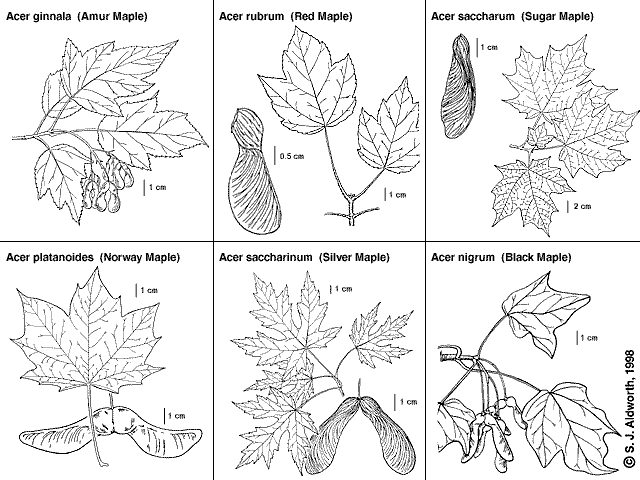
Sugar Maple, Acer saccharum

Amur Maple, Acer ginnala

Silver Maple, Acer saccharinum
Maples come in a variety of shapes, but all can be used to tap liquid for making syrup in the spring.  However, they are also good for their seeds. 

Maple seeds can be eaten!  Hull the seeds from the outer skin.  Taste.  If they are bitter, you can leach the tannin out by repeated boiling.  These can be eaten raw, boiled, roasted, or dried and ground for flour.  The best to eat are the younger ones but even those still on the tree in winter are edible. As they age, the gain bitterness.

Maple leaves are also edible.  Young leaves are preferable because as they age, they contain a chemical that causes anemia.  In the spring and and early summer, you can safely eat a cup every few days.  See this article about Deep Fried Maple Leaves which are popular in Japan.

Inner bark of the Maple can be eaten raw, boiled or roasted.

Clover. White clover is Trifolium repens. Red clover is Trifolium pratense.  Clover leaves can be eaten raw or cooked.  However, the flowers taste better!  I prefer the flavor of red over white.  You can also dry the flowers and grind for flour.  It is one of the easiest wild edibles to find and identify in my opinion.  The plant most often confused for clover is wood sorrel and also edible (tastes lemony).  Wood sorrel is about the same size but the individual leaves are heart shaped rather than round.

This Ginkgo tree is found in the parking lot of Walgreen's.  Ginkgo biloba trees are some of the oldest trees around.  You can see the leaf imprint from millions of years ago that looks exactly the same as today.  The trees are either male or female.  In a commercial environment you will most likely find the male variety as it does not produce the super stinky nut.  The nut is edible and once the messy smelly part is removed, I have read that it is very tasty roasted.  Ginkgo leaves can be used to make a tea which is supposed to improve your memory.


This tree is also next to Walgreen's and is appropriate as it is a Black Willow, Salix nigra.  The bark contains salicylic acid, a chemical compound similar to aspirin.  The bark can be used also a poultice.  Black willow roots are very bitter and have been used as a substitute for quinine in the past.  The leaves are high in vitamin C and can be eaten fresh or dried but they are bitter.  They are more of a famine food.  

Some businesses will intentionally plant food trees.  Here is a peach tree at the car wash! 

The car wash owner also planted blackberries.  While the wild blackberries are gone, the domesticated variety is still producing in September.

Grass.  Yes, you can eat parts of grass, particularly the seed!  If you have eaten wheat, then you already have eaten grass.  The blades of grass, while all domestic varieties are non toxic, can not be digested by our stomachs.  You can chew or make a tea from them to gain some vitamins.  The seeds can be eaten.  Crabgrass, the bane of many lawns, can produce 150,000 seeds per plant.  It is actually used as a staple grain in Africa.

Tulip Poplar tree, you can drink the sweet nectar in the tulip "cups" in the spring. The tree has to be at least 15 years old to produce the blooms.  Planting this tree near bee hives produces a wonderful honey.


Bradford Pear, Pyrus calleryanna, is a relatively new addition in the United States. It is mostly used as a landscaping tree and was sterile when it was introduced in the early 1900's.  However, with competition came the addition of more differing genetics causing many trees, particularly escapees to the wild, to produce tiny "pears."  These have a pear flavor but are very tart.  They can be used to produce a jelly, wine and even a sweet and sour sauce.  The size of the tiny pear produced will vary depending on the genetic make-up of the tree.  I have seen them this size and also nearer to the size of a quarter.  It would be a famine food eaten raw, but cooked, it has a lot of potential.

Sweetgum Tree, Liquidamber styraciflua, produces a spiney green seed pod that actually has the same ingredient as Tamiflu (shikimic acid). You can soak the crushed green Sweetgum fruits in alcohol to make a red tincture.  These have also been boiled in water for a decoction for flu.  The Cherokee made tea out of the bark as an herbal treatment for the flu.  The inner bark was used in folk remedies, boiled in milk for diarrhea and cholera infantum.  In other versions, the bark was boiled with water and sugar to treat bowel complaints of children.  The Lumbee Indians would use the rosin from gashes in the bark made the day before to chew in order to heal gum disease and to counteract the effects of gingivitis.  The rosin may be dried and used as a chewing gum.  Sweetgum salves were also used to treat sores, wounds and ulcers.

The Eastern White Pine is the tree I most often come across. It is one of the few items available even in the dead of winter.  Here's a little shortcut in identification.  White has five letters in the word and an Eastern White Pine has five needles in a bundle.  If you find a Pine tree with five needles in its bundle in North America, you can be very confident that it is an Eastern White Pine.  Most Pine trees can be used to make tea.  You want to avoid choosing Yews (short stubby needles often with red berries), Norfolk Island Pine (frilly, flat, pretty needles often sold as indoor Christmas Trees) and Ponderosa Pine (smells like turpentine and is found growing in the North Western part of the U.S.).

Not only is pine needle tea tasty, but it has 4-5 times the vitamin C of fresh squeezed orange juice and is high in vitamin A.  When the first European colonist arrived in the new world, many were suffering from Scurvy, often with teeth falling out due to the disease.  The Indians introduced them to the use of Pine needles as a remedy and saved many lives.  There are also historic references to sailors adding Pine needles to their beer on long journeys to prevent Scurvy.  It has been a popular herbal remedy for preventing and relieving the symptoms of colds and flues.  Pine needles also contain shikimic acid (Tamiflu). The inner bark of the tree can also be used as a food source if times are truly tough.


Continuing our walk, we can see two different varieties of Hawthorn trees, both of which have nasty thorns!  These trees produce a small fruit called haws.  Haws are used for teas, syrups and jellies and have been used medicinally for hypertension and a variety of heart disorders. There have also been positive studies showing that this fruit lowers "LDL" bad cholesterol.  There are numerous recipes to try.  You can even use it to make ketchup! The berries are tart, but that often is a benefit in recipes, a balance to sweetness. The leaves, berries, and flowers of hawthorn are used to make medicine.


Poke weed, Phytolacca americana, is a much loved and hated plant.  Primarily, this is because if prepared incorrectly, it can poison you, causing vomiting and diarrhea. The compounds thought to be problematic are oxalic acid, saponins (phytolaccotoxin and phytolaccigenin) and an alkaloid (phytolaccin). On the other hand, it's early spring appearance has saved many a settler from starving and even today it is being studied for it's cancer and virus fighting ability.  It is high in Calcium, Phosphorus, Iron, vitamin A, Thiamine, Riboflavin, Niacin and vitamin C.


I have to admit, I love it.  The early spring greens have a flavor like no other.  You would think that by boiling it in two changes of water and then frying it that it would be mush, but it is not.  The leaf is sturdy. The bottom photo is what it looks like when you can pick it.  The top photo is the berries that are often confused with Elderberry.  Once you have seen them, you will never confuse them.

The berries and the roots have been used in folk remedies to treat arthritis, lime disease and even poison ivy.  See Amish Folk Remedies


Elderberries are no longer in season, but it is growing in our path today and worthy of notice.  There are several look alikes that you want to avoid.  One is the poke plant above.  First the elderberry berries, while the same color, are organized quite differently.  Poke berries have a long straight shape while the elderberry berries grow in branched clusters, like the flowers. The leaves of Poke grow in an alternate pattern while the Elderberry leaves grow opposite of each other.  When looking for Elderberries, the bark is smooth and dotted, see photo. 

Another look alike is Devil's Walkingstick, Aralia spinosa,which has similar berries but has a telltale sign as it has thorns.

Fireweed, Erechtites hieraciifolia, is a controversial plant at best.  It was used by native Americans for medicine.  It has a strong flavor that people either love or hate.  Some gourmets use it in sushi and you can find recipes for it online.  However it has the possibility of being poisonous.  A 1939 study determined that it contains pyrrolidines that can damage the liver.  Opinions vary widely as to whether it is edible or toxic.  In my opinion, it would be famine food and certainly cooked before eating. It is thought to be called fireweed because it is often the first plant to appear after the land was devastated by fire.

Horseweed, Conyza canadensi, dried leaves can be used as a herb similar to tarragon.  It is an excellent source for a drill when making fire through friction.  Farmers hate it because it is resistant to many types of herbicides.  Native Americans used it for clotting blood and the treatment of rheumatism and gout.

We've made it to the post office!  Here we find blackberry leaves.  Wild blackberry season is over but the leaves can still be used.  Blackberry leaves can be used in a tea to treat digestive problems, particularly diarrhea. Young tender blackberry leaves can be eaten.


Rosehips, the fruit of the Rose bush, and be used to make a tea or jelly.  Some are better than others.  These are tiny and better for a tea.  They are high in vitamin C.

Eastern Redbud, Cercis canadensis.  I include this because if it were spring, the purple buds would be edible (great in salads or baked goods) or early summer the seed pods would be edible.  You have to catch the seed pods at the right time or they quickly become too tart (before the seeds begin to grow).  They look similar to snow peas.

Common Plantain, Plantago major, one of my favorite wild edibles.  It can be used as a green like spinach.  It has leaves sturdy enough to withstand canning.  To use just slice against the grain to cut the annoying string in the leaves.  It is wonderful sauteed with bacon!  It can also be used to make a wonderful salve to treat bug bites and other skin conditions.  It is actually one of the best I have ever used.


Dandelion leaves, Taraxacum officinale, are one of the best eating greens available.  They have more calcium and iron than most cultivated greens.  The roots can be roasted, ground and used as a coffee substitute.  The flowers can be made into wine...surprisingly good wine!  I dry the leaves and add them to soups and stews all year.

Goldenrod, Solidago canadensis, or Solidago virgaurea, is used primarily as a tea to reduce pain and swelling (inflamation).  It is a diuretic that increases urine flow and stops muscle spasms.  It is also used to treat gout, joint pain, arthritis, eczema and skin conditions.  In the past, it has been used to treat turburculosis, diabetes, liver enlargement, hemorrhoids, internal bleeding, hay fever, asthma and enlarged prostate.  It is great for your urinary tract.

It can be used as a mouth rinse for inflammation of the mouth and throat. It can be applied directly to skin to improve wound healing.

Other sources indicate that it lowers blood pressure and fights infections.  Contrary to what many believe, it does not cause seasonal allergies.  It blooms at the same time as Ragweed but its pollen is too large. It does cause contact allergies in some people.

All above ground parts can be dried and used for a fragrant tea.


As we wind our way around Home Depot, this is what we find!  Also a favorite wild edible, though many hate it with a passion.  This is Kudzu and everything but the seeds is edible.  The leaves are particularly good at being dehydrated.  I eat them raw as well, but they are a little chewy.  I add them to soups and sauces all year.  It's a great way to sneak in nutrition.  The flowers make a wonderful jelly.  The roots can be ground and used as a thickener but I have yet to try it.  If you live near a site such as this, you will never starve. It takes five minutes to pick enough to fill two dehydrators.


Also in front of Home Depot you will find wild grapes.  The exact species of grapes can be difficult to determine but these are most likely frost grapes.  They are tiny and tart with a thick skin.  They sweeten after a frost if the birds leave them alone that long!  They make some of the best jelly I have ever made.  It is my daughter's favorite.  Grape leaves can also be eaten.  You can can them as well for winter use.

Rounding the corner to the area in front of Publix you will find Yucca. If it were spring, you would see a stalk extending from the center and lovely white flowers.  These flowers and even the stalk are edible.  The flowers are crunchy and are often fried, diced for soups or pickled.  They are best eaten young as they get bitter with age.  The roots can be used as soap.


Sawtooth Oak, Quercus acutissima, is in the same family as the first photo, but as you can see, the leaves are completely different.  This tree is a native of Eastern Asia, introduced in the US in 1920. It is fast growing and produces acorns in as early as five years.  Sawtooth oaks are not red or white but from a group called "cerris" which has traits that are somewhat between white and red.  Deer love these acorns.  These can be leached of their tannin and ground for flour.

A little tip about acorns, usually the cap is an indicator of tannin strength.  The bigger the cap the more tart the acorn.


Eastern Cottonwood, Populus deltoides, in the willow family, has bark that contains salicin, a glycoside that decomposes into salicylic acid (aspirin). It has been used to treat inflammation, rheumatism and fever.  The inner bark, known as cambium, can be eaten raw or cooked.  It is usually dried, ground into powder, and used as a thickener in soups or to make bread.  Not only was it used by Native Americans but also by people of Europe and Asia.  It is high in vitamin C. 

The leaves are rich in protein and have a greater amino-acid content than corn, rice, wheat and barley. A poultice of the leaves has been used to treat rheumatism, bruises, sores and boils. The sap of the tree can also be enjoyed as a drink.

That ends our tour of a typical commercial shopping area!  Hopefully you have found enough to eat to avoid the zombies!