Tuesday, July 16, 2013

Spicy Wild Blackberry Chipotle Glaze!


This is sooooo good! I wanted something other than a jelly for the abundant wild blackberries that proliferate much like weeds in my area. While jelly is great, there is only so much that you can use or give away! This glaze is excellent on meat or as a dipping sauce. It is spicy, but that is how we like it!

Spicy Blackberry Chipotle Glaze
Based on the original recipe at Driscoll's Berries

Ingredients:

2 t olive oil
2 c diced onion
6 cloves garlic
4 T chipotle chilies in adobe, chopped
3 quarts blackberries (12 cups)
1 1/2 cups balsamic vinegar
Juice from 1 lime
1 c sugar
2 t salt

Directions:

Cook onion in oil for 4 minutes. Add garlic and cook 2 minutes. Add chilies and cook for 1 minute more.

Add remaining ingredients and bring to a boil. Reduce heat and simmer for 40 minutes.


Purée in food processor or blender. Strain in fine mesh to remove seeds. This will reduce mixture significantly but do not be concerned, the end product is worth it!


Return to heat and cook for an additional 10 minutes.

Ladle into 6 half pints. Boil in water bath for 15 minutes.


Monday, July 8, 2013

Foraging Finds!

Not sure what I am going to do with these yet, but it is exciting to discover new plants!


Chokecherries

Passionflower/Maypop is Tennessee's Official Wild Flower

Fruit of the Passionflower/Maypop
All found in Franklin, TN!

The Best and Easiest Strawberry Rhubarb Pie!


Often when you explore old abandoned homesteads you will find three plants: Strawberries, rhubarb and apple trees.  Homesteaders plant these because they only need planting once and then provide years of produce.  So while the people may disappear, the plants remain as a remnant of a past life.

This year, I planted, you guessed it, strawberries, rhubarb and another apple tree!  While the strawberries did very little, the rhubarb really took off!  While I wish I was a "green thumb," I am not.  However, rhubarb makes me look good, and I will plant it forever after now! 

Rhubarb in the center, one of the first plants to really take off!

My husband has fond memories of strawberry rhubarb pie growing up in Northern Michigan.  I made this recipe for him, and while we are not huge dessert people, this disappeared by the next day!  He could not stop eating it!  While it is great hot and fresh, he says it is even better the next day, and I would have to agree.

Strawberry Rhubarb Pie

Ingredients:

double pie crust (your favorite homemade or store bought)

3 cups diced strawberries
2 cups thinly sliced rhubarb
1 1/3 cups plus 2 tsp. sugar
1/3 cup all-purpose flour
1/2 tsp. ground nutmeg
1/2 tsp. ground cinnamon
2 tbsp. butter, cut into small pieces
2 tsp. milk

Directions:

Preheat oven to 400 degrees.  Cut up strawberries and rhubarb.


In a large mixing bowl, mix 1 1/3 cups sugar, flour, nutmeg and cinnamon.  Add fruit and toss to coat.

Grease pie plate and lay the bottom crust.  Spread fruit mixture on it. 


Dot fruit mixture with butter.  Lay top crust over mixture.  Using a fork, press edges of crust together.  Slice several vent holes in crust.  Brush with milk and sprinkle with remaining 2 tsp of sugar.

Bake for 50 minutes.  At the 25th minute, check crust.  If it has browned to desired level, cover with aluminum foil.

Best served hot with vanilla ice cream!

Sunday, July 7, 2013

Milkweed, My New Favorite Vegetable!

Milkweed in bloom, unopened buds on top.
About a month ago I was exploring one of our local parks when I came across a beautiful and unusual plant.  I knew that it was either going to be something great or super poisonous because it was unlike any other plants around it.  It turned out to be something great!

While milkweed is no longer a commonly eaten plant, it was once frequently consumed by Native Americans and early colonists.  There are numerous toxic look-a-likes, namely dogbane and butterfly weed, so if you are interested in harvesting the plant, be sure and study the plant and its look-a-likes.  Just for information, dogbane's stalks are solid while milkweed's stalks are hollow, and milkweed has a white sap while butterfly weed's sap is clear.  In my opinion, it is difficult to miss common milkweed as it is so unique, especially when the flowers are in bloom. 

Milkweed buds, or the unopened flowers, are the part of choice on this plant.  The flowers are shaped like a pom-pom and are quite beautiful when they open.  Each bud in the pom-pom is slightly smaller than a pea.  It has been recommended online that you should boil milkweed in several changes of water to remove the bitterness.  I can only assume that those writers had never eaten milkweed, a conclusion shared by numerous milkweed eaters.  These are delicate and while I did boil mine for several minutes, to do it several times would result in mush.  I also did not detect any bitterness after the initial boil.  It tasted like a very mild asparagus, which I would be quite willing to eat over and over.  It is probably one of the easiest vegetables to cook.  My husband enjoyed it as well.  The kids, well, unless it is a green bean, will not even attempt it, no offense to milkweed.

Garlic Butter Sauteed Milkweed

Ingredients:

2 cups of milkweed buds (about a lunch size paperbag of collected milkweed buds)
3 garlic cloves crushed
2 tablespoons butter
2 tablespoons soy sauce
salt to taste

Directions:

Bring saucepan of water to boil.  Cut buds from milkweed pom-pom.  Leave the stems as they are soft and tasteless.


Drop buds in boiling water for two minutes.  Drain.

In frying pan, cook butter and crushed garlic for several minutes.  Add milkweed buds and fry for three to five minutes.  Add soy sauce and salt to taste. 


Serve alone or over rice.


Check out these other great milkweed recipes:

Milkweed Bud Capers
Milkweed Bud Cheddar Soup
Cream of Milkweed Flowerbud Soup

As with any wild plant, do your research and only try a little in the beginning to see if it is agreeable to you.

Tuesday, July 2, 2013

Foraging Around Franklin, Tennessee!

Blackberries, Crab Apples & Milkweed Buds

It's blackberry season around here!  Today I found about a third of the blackberries on the shrub ready for picking (Winstead Park in Franklin, TN).  It's also a great time to start picking crab apples for making jelly (PGS in Franklin, TN).  They are not completely ripe yet which is what you want to get the most pectin.  I also found some milkweed buds (Winstead Park in Franklin, TN) which is great for soups and stir fry. 

Happy hunting!

Making Filé with Sassafras Leaves

Filé
Imagine the world as we know it has ended, or you are stranded in the woods.  You have shot a squirrel and picked some dandelion greens to make a soup.  It is going to be a rather thin and uninteresting soup to be sure.  However, if you know how to make Filé (fee-lay). you will be able to turn that thin soup into something thicker and far more interesting.  All you need to be able to do is recognize a Sassafras Tree.

Filé is a spice made and used primarily by the Cajuns of Southern Louisiana and invented by the Choctaw Indians. It's used as a thickener and flavoring in soups and stews. If you have had Gumbo, you have probably eaten it already. People often think that Filé is a combination of spices due to its interesting flavor.  Surprisingly, it has only one ingredient, dried Sassafras leaves.

The Sassafras tree is fairly easy to recognize.  The leaves on the tree comes in three different varieties.  These shapes include a simple oval, a three-lobed maple leaf shape, and a two-lobed mitten shape.  The Mulberry tree also has these three shapes, however, the Sassafras has smooth margins and no teeth and also has a spicy smell when crushed.  If you pull the leaf off and immediately smell where the leaf is severed, it should have a spicy almost citrous scent.  Sassafras is a medium-sized tree with irregularly furrowed, red-brown bark.

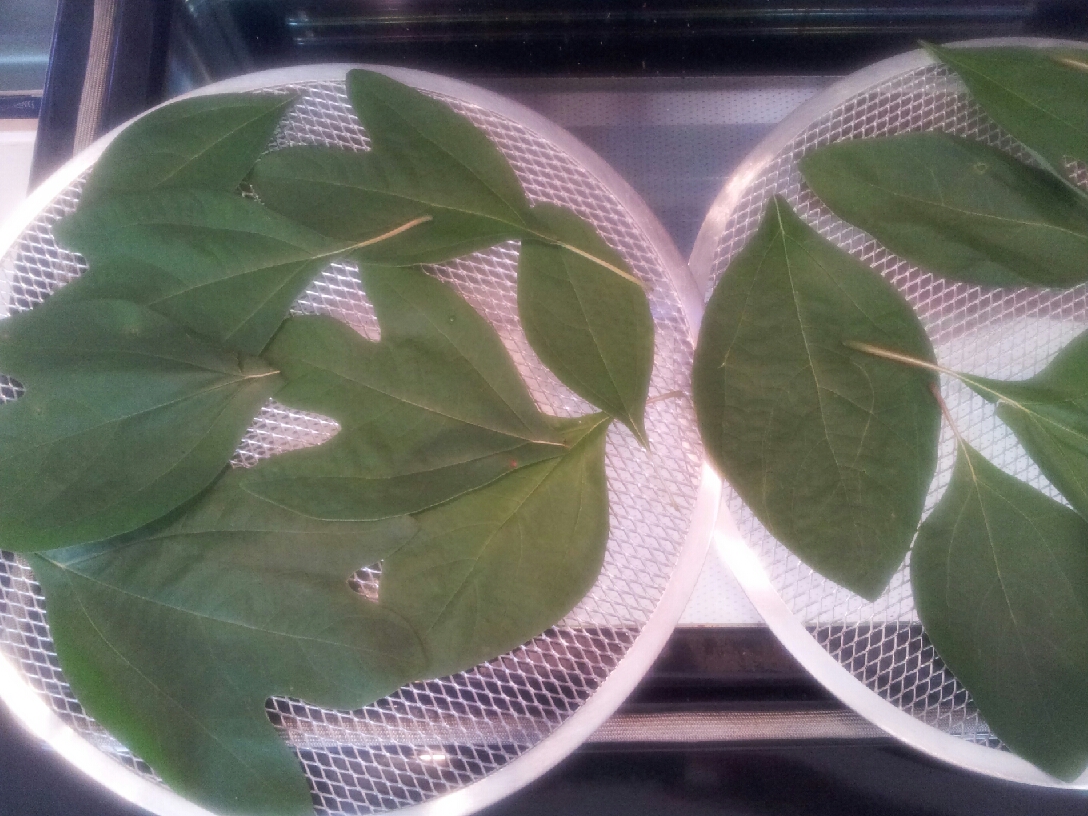
To make Filé, you can pluck branches off and hang to dry in a warm area like a garage or attic.  Your branches will be crispy dry in about a week.  You can also pluck individual leaves off and dehydrate them in a dehydrator or oven.  See how I dehydrate HERE.  Do not dehydrate your leaves in the sun as it will dull the color of the leaves.


Once dry, hand crush the leaves in a bowl.  It will suddenly seem like a much smaller amount at that point.  Fill your mortar 3/4 full and using a pestle, crush into a powder.  It takes about five minutes.


Strain through a fine mesh strainer to remove any large pieces and twigs.


Store in an air tight container away from sunlight.  To use, add several teaspoons to your soup after you have taken the soup away from the heat.  Do not add it while cooking.  Be frugal in your initial use as often people add too much in the beginning.  You can also use it as a condiment for individuals to add to their soup.

As a point of interest, sassafras root and bark are have been sources of the flavoring for root beer in the past. The roots also make a wonderful tea which I drank often as a child.  Native Americans used Sassafras as a blood purifier.  Some locals that I have known use the root in tea to help get over colds and fevers. Herbalists use Sassafras for arthritis, gout and rheumatism.

Parts of the sassafras plant contains safrole, which may be carcinogenic according to the FDA.  In the 1960's, researchers isolated this compound of Sassafras and fed it to rats in ridiculously high concentration (not found in nature) and they developed cancer (go figure, keep in mind that they had not even decided that cigarettes caused cancer at this point so my faith in this determination is fair at best).  You can also find safrole in more common herbs such as black pepper, basil and nutmeg.  However, just to be on the safe side, the leaves of Sassafras do not contain safrole so they are safe for making Filé!

For you locals, there is a Sassafras tree behind Home Depot on Royal Oaks in Franklin, TN.

Shared At:
Homestead Barn Hop
Natural Living Monday
Backyard Farming Connection
Eco-Kids Tuesday
Frugal Days, Sustainable Ways
The HomeAcre Hop
 

Monday, June 24, 2013

Dehydrating Curly Dock, Plantain and Watercress

My recent foraging trip: Curly Dock Seeds, English Plantain, Curly Dock Leaves and Yucca Flowers.

I have a secret.  I am not very good with fresh vegetables.  They have a tendency to rot in my fridge.  I will put them in the vegetable drawer with great expectations and two weeks later I rediscover them only to end up in my compost bin.  You would think someone interested in foraging and plants would be on top of this but, alas, it is not so.  I have, however, discovered a way that I can easily preserve my greens and use them on a regular basis.  While I do poorly at sauteing them when they are fresh, I am great at throwing a handful into spaghetti, chili or a crockpot of beans.  Even my kids will eat them then.

If you have a dehydrator, then you should follow the directions of the dehydrator.  I do not have one.  I use my oven.  Fortunately, it has a convection option which makes it easier, but you can also do it with bake though it may take longer.  First, I pick, wash and cut up the greens.

Curly Dock leaves ready for dehydrating.

I then put them on a metal pizza pan that has small holes in it.  I recently purchased mesh pizza pans on eBay that I think will work even better.


Turn your oven on to convection at 130 degrees.  It takes between 3 to 4 hours for me to completely dehydrate greens.  You should mix them up every hour.


Store in a jar and toss a handful into whatever you are cooking to add nutrition and a bit of flavor.  I have found that greens lose some of their really strong flavors when you dehydrate them.  I personally like that as it is easier to put into recipes.  Also, if you are working with greens that are stringy, like plantain, it no longer is an issue once dehydrated.  The leaves easily crumble.  Remember to check the bottom of your oven after dehydrating for any stray dehydrated greens.  It makes an unpleasant odor when you use it to cook with next.  Guess how I know?


You can dehydrate most greens in this way.  Curly Dock seeds should be destemmed and and rinsed in several changes of water and drained.  I do not take the husk off of the seeds.  Layer them on your pan and placed in a 170 degree oven until completely dried.  Mix them up every hour or so.  Once dried, I have found that a blender works the best to grind up for use in baked goods.  However, certain grain mills would probably work better.  My hand crank grain mill would have taken me all day to grind a few cups. I also tried my food processor which did basically nothing.  In my experience, you can add two tablespoons of ground curly dock seed into most bread recipes without changing the flavor much and you add nutrition and fiber.  There are recipes that use Curly Dock flour as a primary ingredient which I will share later.

Adding dried watercress to pasta sauce. Yumm.